
Blog

- By Admin
- Aug 04, 2026
PA 603-CF for UAV Parts: When It Makes More Sense Than Machined 6061-T6 Aluminum
When a UAV program is moving from concept to prototype validation, the biggest delays rarely come from CAD. They come when a promising design meets the realities of manufacturing: long machining lead times, too many assembled parts, avoidable weight, and one more revision cycle that pushes testing further out. For engineering and procurement teams under pressure to move quickly, that is where material selection stops being a theoretical exercise and becomes a program decision.
For many prototype and validation-stage UAV components, PA 603-CF offers a practical alternative to machined 6061-T6 aluminum. Through SLS, it gives teams more freedom to redesign around weight, geometry, consolidation, and iteration speed instead of staying locked into shapes that are easy to machine but not always ideal to fly.
That does not mean PA 603-CF replaces aluminum everywhere. Objectify approaches that decision as an engineering choice, not a blanket material switch. With ISO 9001:2015 and AS9100 Rev D certifications, the focus is on helping teams identify where additive manufacturing creates a measurable advantage and where conventional machining should still remain the preferred route.
Why PA 603-CF matters in UAV development
Prototype and validation-stage UAV programs usually have a different priority set than mature production. At this stage, the question is often not “What is the cheapest part at scale?” but “What gets the right part into testing faster, with less assembly complexity and better weight performance?” That is why additive manufacturing becomes especially relevant early in the development cycle.
PA 603-CF is often evaluated in this context because it combines the design flexibility of SLS with the performance profile expected from a carbon-fibre-reinforced PA12 / nylon material. The result is a material option that can be useful for UAV airframe elements, payload enclosures, brackets, mounts, and other geometries where lightweighting and part consolidation matter as much as raw metal strength.
A design team that stays with machined 6061-T6 by default may end up carrying over legacy assumptions from conventional fabrication: split a geometry into multiple parts, simplify curves, avoid enclosed features, and add fasteners later. That logic makes sense for machining. But when the design objective is flight-ready validation, it can create unnecessary mass, more assembly points, and slower revisions.
PA 603-CF vs 6061-T6
The original comparison makes an important point: PA 603-CF and 6061-T6 aluminum are not competing on every property equally. 6061-T6 retains a clear advantage in raw stiffness, tensile strength, ductility, and high-temperature performance. That matters for components with demanding structural loads, significant deformation requirements, or thermal conditions where metal remains the safer engineering decision.
Where PA 603-CF becomes compelling is in the overall system trade-off. It is significantly lighter than aluminum on a volume basis, and that matters in UAV design because every gram affects payload margin, battery allocation, and platform efficiency. The draft also highlights additional advantages such as corrosion resistance and reduced dependence on secondary treatments like anodizing in applications where aluminum would otherwise require extra protection.
In practical terms, the better question is not which material looks stronger in a datasheet table. The better question is which material helps a specific UAV component meet its function with the least penalty in mass, lead time, assembly effort, and redesign friction.
What that means for the engineering team
For engineering leaders, PA 603-CF is worth considering when a component has one or more of these characteristics:
• It benefits from lower mass.
• It has geometry that is difficult, expensive, or inefficient to machine.
• It can be consolidated from multiple parts into one printable assembly.
• It is likely to go through several design revisions before final validation.
• It does not depend on the thermal conductivity or ductility advantages of 6061-T6 aluminum.
For procurement teams, the value is just as practical. SLS does not require dedicated tooling in the same way CNC-led development often depends on fixtures and repeated setup effort. That can make early-stage sourcing more responsive when designs are still changing.
Where PA 603-CF fits best
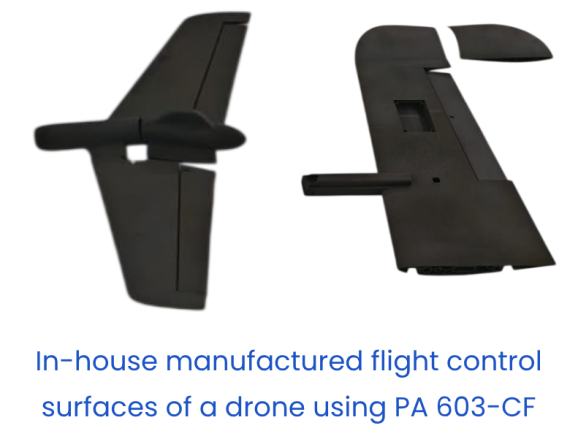
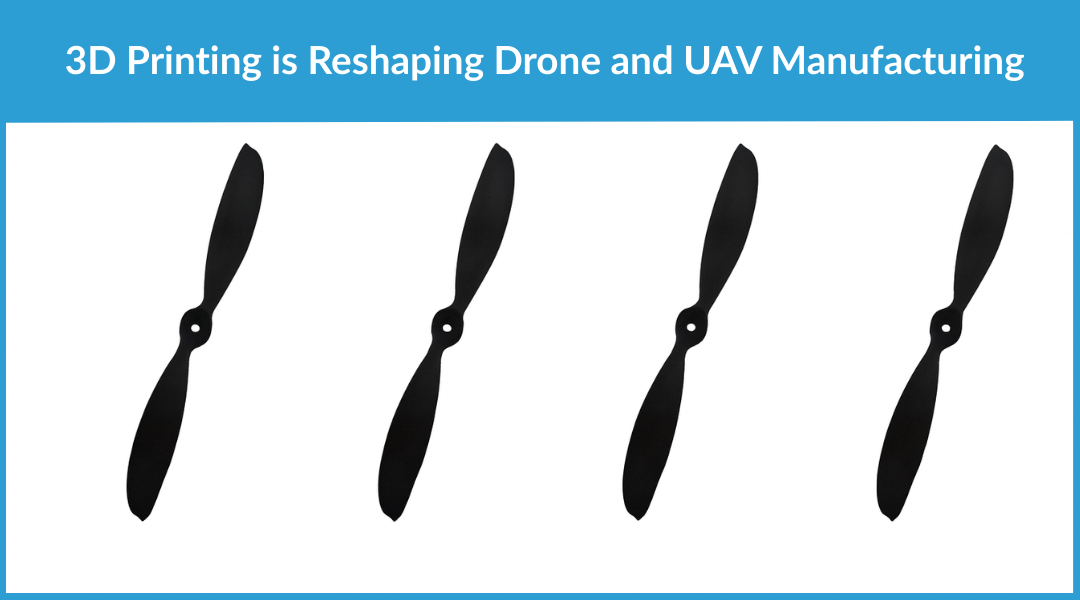
In UAV programs, PA 603-CF is often a strong fit for parts that sit at the intersection of lightweighting, design complexity, and development speed. That can include airframe substructures, payload enclosures, brackets, mounts, aerodynamic covers, internal support geometries, and example parts such as flight-control surfaces produced for UAV applications.
These parts are good candidates not because they are “non-critical,” but because they often reward redesign. A machined bracket may begin as a simple metal component, but once the design is rethought for additive manufacturing, it may become lighter, require fewer fasteners, and integrate mounting or routing features that would otherwise take several secondary operations.
That redesign mindset is where the strongest gains usually happen. Instead of asking whether PA 603-CF can copy an aluminum part exactly, the better approach is to ask whether the part should still look like a machined part at all. In many SLS workflows, the answer is no.
Decision matrix
The simplest way to evaluate PA 603-CF against machined 6061-T6 aluminum is to match the material to the part requirement.
| If the component needs… | Better fit |
| Lower mass and faster design iteration | PA 603-CF |
| Complex geometry or part consolidation | PA 603-CF |
| Enclosures, brackets, mounts, and lightweight UAV substructures | PA 603-CF |
| Small batch prototype or validation builds | PA 603-CF |
| High thermal conductivity | 6061-T6 aluminum |
| Higher ductility or substantial plastic deformation tolerance | 6061-T6 aluminum |
| Very high stiffness and strength as the dominant requirement | 6061-T6 aluminum |
| Simple geometries that are already efficient to machine | 6061-T6 aluminum |
This matrix is not a substitute for engineering validation. It is a faster way to screen which parts deserve an additive manufacturing review first.
A representative UAV redesign scenario
Consider a drone manufacturer preparing a validation build for a revised payload system. The original assembly uses multiple machined aluminum brackets, separate mounting features, and additional hardware to fit around wiring and payload constraints. It works, but each revision takes time, and every design adjustment means updating more than one part.
Now imagine that assembly redesigned for PA 603-CF through SLS. The support geometry is consolidated, cable-routing features are built in, mounting points are integrated, and unnecessary mass is removed from non-load-dominant regions. The result is not simply “the same part in plastic.” It is a different design strategy aimed at producing a more test-ready component faster.
That kind of redesign is where additive manufacturing tends to justify itself early. The value is not only in the printed part. It is in shortening the path between engineering intent and physical validation.
Objectify capabilities for UAV programs
Objectify supports UAV development with an additive manufacturing workflow designed for engineering-led evaluation, prototyping, and small batch production. That includes SLS production, in-house depowdering, bead blasting, dyeing, vapor smoothing, heat-set inserts, machining, painting, sealing, and assembly.
For teams evaluating PA 603-CF, this matters because component performance is influenced by more than printability alone. Surface finish, secondary processing, inserts, finishing quality, and part readiness for installation all affect how efficiently a prototype moves into validation. Visual proof also matters, which is why example UAV parts such as flight-control surfaces can strengthen the credibility of the article when included alongside this section.
The most effective engagements usually begin with part selection. Some components are excellent candidates for PA 603-CF. Others are better left in machined 6061-T6 aluminum. The value of the review is in making that distinction early.
Request a quote
If your team is evaluating PA 603-CF for a UAV component, the fastest next step is to share your 3D file with Objectify through the contact page. The team can assess additive manufacturing suitability, identify whether the design is a strong candidate for SLS, and begin the quoting process based on geometry, application, and finishing requirements.
Objectify can provide an additive manufacturing feasibility review within 48 hours, helping your engineering and procurement teams move from concept discussion to manufacturable direction without unnecessary delay. The team can also share the PA 603-CF material datasheet on request during the quoting and feasibility review process.
Reference URLs



Leave a Reply